From School Administrator, August 2022
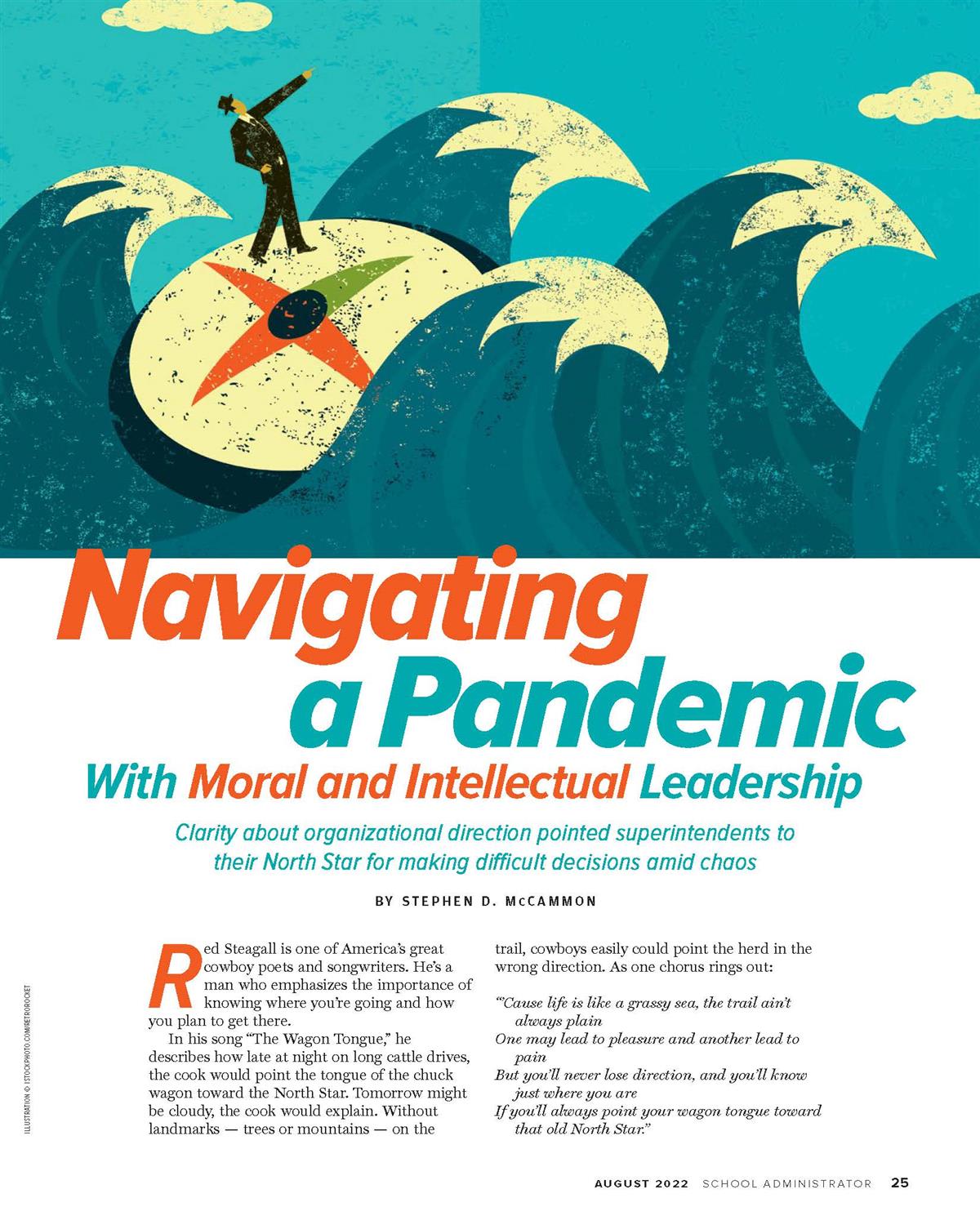
Red Steagall is one of America's great cowboy poets and songwriters. He's a man who emphasizes the importance of knowing where you're going and how you plan to get there
In his song "The Wagon Tongue," he describes how late at night on long cattle drives, the cook would point the tongue of the chuck wagon toward the North Star. Tomorrow might be cloudy, the cook would explain. Without landmarks - trees or mountains - on the trail, cowboys easily could point the herd in the wrong direction. As one chorus rings out:
"'Cause life is like a grassy sea, the trail ain't always plain One may lead to pleasure and another lead to pain But you'll never fuse direction, and you'll know just where you are lf you'll always point your wagon tongue toward that old No1th Star."
In the pain-filled past two school years that we have all experienced, it is clear, in the face of a terrible pandemic, the best leaders understood their North Star to be commitment to the moral and intellectual foundations of the school district enterprise.
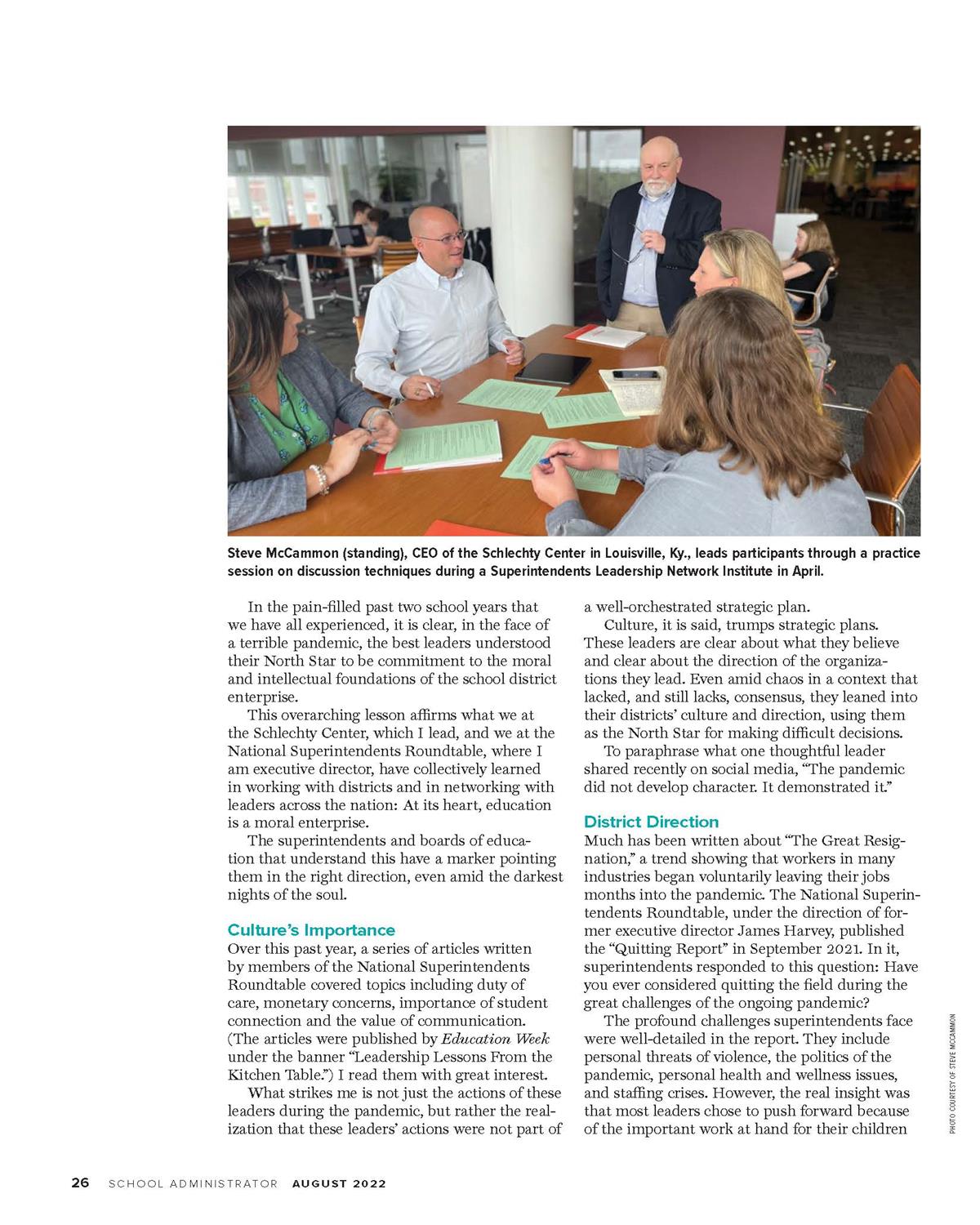
This overarching lesson affirms what we at the Schlechty Center, which I lead, and we at the National Superintendents Roundtable, where I a1n executive director, have collectively learned in working with districts and in networking with leaders across the nation: At its heart, education is a moral enterprise.
The superintendents and boards of education that understand this have a marker pointing them in the right direction, even amid the darkest nights of the soul.
Culture's Importance
Over this past year, a series of articles written by members of the National Superintendents Roundtable covered topics including duty of care, monetary concerns, importance of student connection and the value of communication. (The articles were published by Education Week under the banner "Leadership Lessons From the Kitchen Table.") I read the one with great interest.
What strikes me is not just the actions of these leaders during the pandemic, but rather the realization that these leaders' actions were not part of 26 SCHOOL ADMINISTRATOR AUGUST 2022 a well-orchestrated strategic plan.
Culture, it is said, trumps strategic plans. These leaders are clear about what they believe and clear about the direction of the organizations they lead. Even amid chaos in a context that lacked, and still lacks, consensus, they leaned into their districts' culture and direction, using them as the North Star for 1naking difficult decisions.
To paraphrase what one thoughtful leader shared recently on social media, "The pandemic did not develop character. It demonstrated it."
District Direction
Much has been written about "The Great Resignation," a trend showing that workers in many industries began voluntarily leaving their jobs months into the pandemic. The National Superintendents Roundtable, under the direction of former executive director James Harvey, published the "Quitting Report" in September 2021. In it, superintendents responded to this question: Have you ever considered quitting the field during the great challenges of the ongoing pandemic?
The profound challenges superintendents face were well-detailed in the report. They include personal threats of violence, the politics of the pandemic, personal health and wellness issues, and staffing crises. However, the real insight was that most leaders chose to push forward because of the important work at hand for their children and local communities. They were connected. My colleagues and I have heard amazing stories of how teachers and principals responded during the pandemic by reaching out to their communities and families.
But it is the superintendent, with the support of the board, who is responsible for the school district's direction, what we at the Schlechty Center think of as "directional systems." Our founder, Phillip Schlechty, defined directional systems as "systems through which goals are set, priorities are determined and, when things go awry, corrective actions are initiated."
Schlechty never drove cattle, but because he understood the importance of being clear about district direction, he understood the 1netaphor of the wagon tongue and shared it often. I am not sure he would have anticipated school leaders being pulled in so many directions, on so many difficult issues fraught with political passion, such as our nation witnessed these past few years.
However, he would have had no difficulty understanding the need for leadership firmly anchored in the moral and intellectual dimensions of schooling amidst a national crisis. To him, that's what school leadership was all about.
School and district leaders who are overly focused on bureaucratic matters ask the wrong questions. Relying on power and control, compliance and lines of authority, they worry about who is in charge instead of where they are going. They are concerned \vith such questions as these: Who's in charge of what? Who decides? How are things decided? What are the standards of performance? Who judges the performance? And what metrics are used in reaching these judgments?
Alternatively, leaders committed to the 1noral and intellectual foundations of their organizations ask a different set of questions: What are the core values and beliefs we want our organizations to embrace and uphold? What accomplishments will make us most proud? What will it take to satisfy those we intend to serve?
Other key questions are: What kind of organization are we, and what do we want to become? How do we identify, import and develop the knowledge we need to engage in the kinds of continuous innovation required to survive and thrive in a constantly changing environment? How will we know when we succeed, and how will we measure success?
Moral Duty
Organizational leaders who are accustomed to exploring issues of values and belief - instead of debating who's in charge - know instinctively where to turn when a nearly unimaginable crisis strikes. They are skilled at refraining proble1ns into opportunities. In observing what superintendents do, we at the Schlechty Center see patterns that we refer to as the Pillars of the Superintendent as:t,.1oraal nd Intellectual Leader (see related story, below). While it's possible the superintendents who responded most effectively to the COVID-19 pandemic were unaware of these pillars, we have no doubt their leadership during this once-in-a.century crisis reflected the principles embedded in the pillars. Outstanding superintendents perched on the moral foundation of the profession insist on a duty of care to others. They continuously clarify their vision of the future, calling for collaboration with peers, insist that trust in their organization and in their people is the key to success, and stand up to harsh personal criticism for doing the right thing because they know it is the right thing to do.
Two Exemplars
While I could highlight so many leaders who rose to the occasion these past few years, two come to mind who truly embodied the moral and intellectual leader: One is Michelle Reid, who found herself facing the decision to be the first school district in the nation to close schools due to the sudden appearance of COVID-19 when she was superintendent of Northshore School District in Washington. She had no roadmap and no precedent to guide the difficult decision.
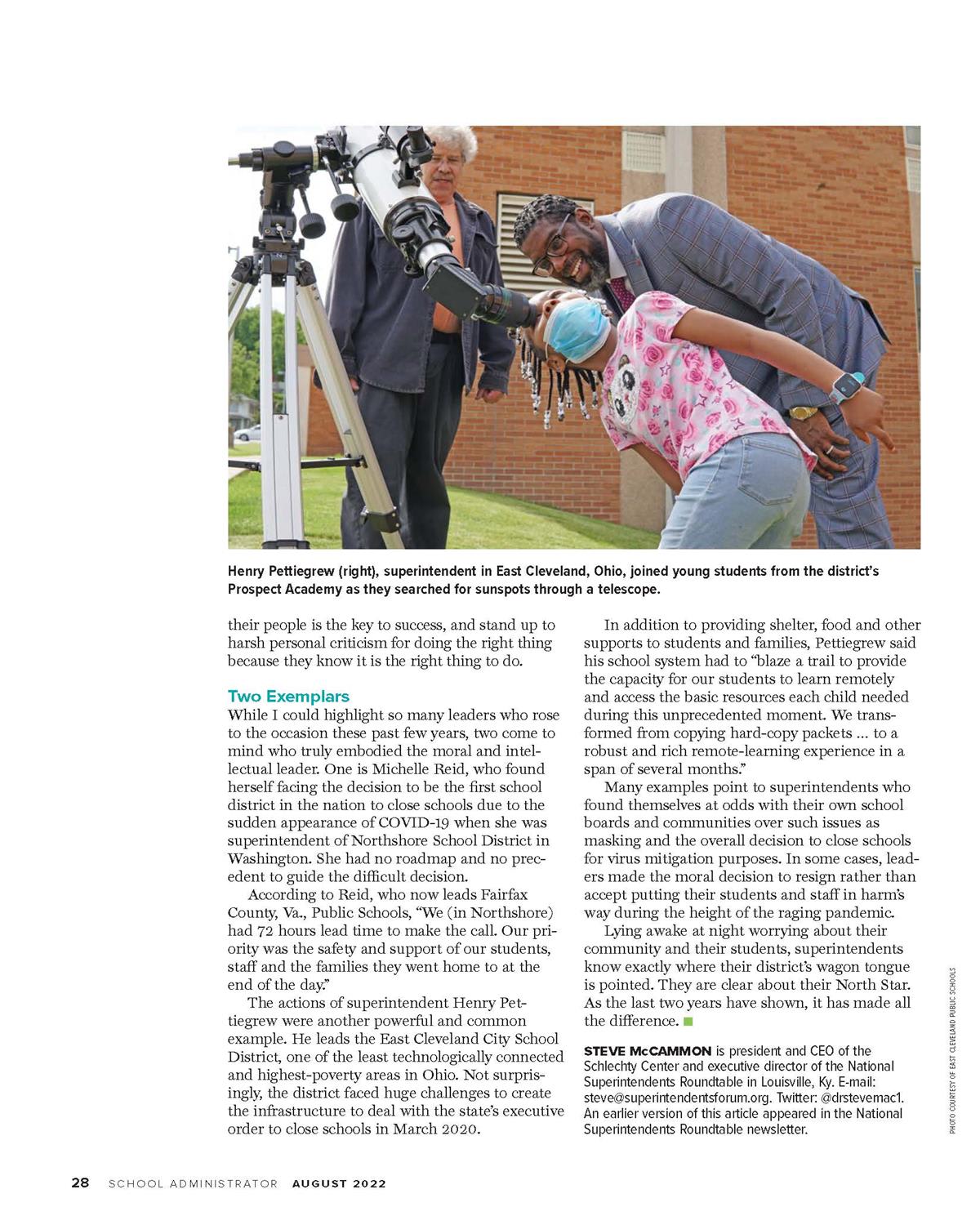
According to Reid, who now leads Fairfax County, Va., Public Schools, "We (in Northshore) had 72 hours lead time to make the call. Our priority was the safety and support of our students, staff and the families they went home to at the end of the day." The actions of superintendent Henry Pettiegrew were another powerful and common example. He leads the East Cleveland City School District, one of the least technologically connected and highest-poverty areas in Ohio. Not surprisingly, the district faced huge challenges to create the infrastructure to deal with the state's executive order to close schools in March 2020.
In addition to providing shelter, food and other supports to students and families, Pettiegrew said his school system had to "blaze a trail to provide the capacity for our students to learn remotely and access the basic resources each child needed during this unprecedented moment. We transformed from copying hard-copy packets ... to a robust and rich remote-learning experience in a span of several 1nonths."
Many examples point to superintendents who found themselves at odds with their own school boards and communities over such issues as 1nasking and the overall decision to close schools for virus mitigation purposes. In s01ne cases, leaders made the moral decision to resign rather than accept putting their students and staff in harm's way during the height of the raging pandemic.
Lying awake at night worrying about their community and their students, superintendents know exactly where their district's wagon tongue is pointed. They are clear about their North Star. As the last two years have shown, it has made all the difference. ■
Pillars of the Superintendent as Moral and Intellectual Leader
These pillars, as created by George Thompson, past president of the Schlechty Center, describe the traits and actions of a strong moral and Intellectual leader. They are described frequently as aspirational, but in these past two years of the pandemic, they became real.
A strong moral and Intellectual leader:
Models and develops trust. Gives priority to building personal trust and trust In the organization.
Clarifies 1he vision. Consistently and continuously communicates and clarifies a clear and compelling vision of the future.
Knows what he or she believes. Understands the need to be clear about what he or she believes and understands that shared beliefs are the foundation of the direction of the organization.
Enhances capacity. Attends to developing the capacity of the organization and the capacity of the people who are part of the organization to support continuous Innovation.
Educates community. Educates the community, especially community leaders, and informs policymakers about the condition of
Thinks and acts strategically. Employs systems thinking to understand how systems are linked to one another and how they interact.
Personalizes relationships with principals. Develops personal relationships with all principals in the district
Unifies central-office staff. Educates central-office staff so they understand and are committed to the direction In which they are being led.
Shares authority. Shares authority rather than delegates it. Views authority as affective and highly personalized.
Personalizes his or her relationship with the board. Strives to work as part of a team with the board in order to focus on the needs of children and the future education. of the community.
More about the pillars of leadership can be found on the Schlechty Center website https://www.schlechtycenter.org.
Steve McCammon is president and CEO of the Schlechty Center and executive director of the National Superintendents Roundtable in Louisville, KY [email protected] An earlier version of this article appeared in the National Superintendents Roundtable newsletter