From National Superintendents Roundtable August 2, 2022 "Roundtable News"
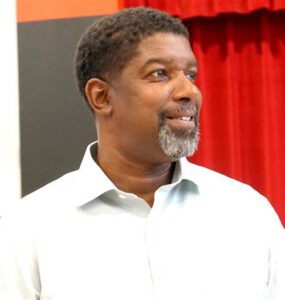 Handed a big stick with which to beat East Cleveland City School District into shape, new CEO Henry Pettiegrew put the stick in a closet and went around the district “like Columbo,” asking questions. The result? Buy-in for a new way of doing business from faculty, central office staff, and the board. A trimmer and leaner East Cleveland City School District. Extensive community revitalization. And East Cleveland, the last of three school districts in the state of Ohio to be put into state receivership has, like the others, been approved to regain
local control after successfully completing an academic improvement plan. The arc of progress from community opposition to community buy-in can be followed in outline here with this brief video.
Background. House Bill 70, enacted in 2015, created a state takeover process for school districts that received an overall “F” grade on state report cards for three consecutive years, said Pettiegrew in an extremely impressive July presentation to the Roundtable. The bill authorizes a financial supervisor (CEO) to take away the decision-making ability of the local board of education. The provisions of the bill were subsequently enforced against three Ohio districts: Youngstown schools in 2016, Lorain in 2017, and East Cleveland in 2018.
East Cleveland is a community currently of some 13,500 residents, having lost 2,000 people during the pandemic. The community is impoverished. “It’s a food desert,” said Pettiegrew, without a single grocery store in its 3.3 square miles. “It’s also a digital desert.” Adding to the complexity, just 40% of parents and guardians are East Cleveland residents; the rest “are from all over the place in Northeast Ohio.” Meanwhile, PTAs were moribund, and there had not been a union contract for 15 years.
With an enrollment of about 1,300 students, 99% of them eligible for free- and reduced-price meals, East Cleveland is “the fourth poorest community of its size in the country,” he said. “Try to picture the students we serve as they walk past abandoned houses on their way to school.”
Authority: A big stick. House Bill 70, reported Pettiegrew, gave him enormous authority. As CEO, he said, “I had the power of the superintendent and the board of education … It was my sole responsibility to right the wrongs of the district.
I’m sorry, but that’s a ridiculous thing for one person to try to do.”
“The rumor was that I was going to fire everyone and would toss out all the traditions and culture of East Cleveland. I would come in and be very disruptive because that’s what a state takeover is all about.” Pettiegrew ran into a lot of community resistance and lawsuits about whether he should even have his position. Amidst all this, about 12 months after he came on board, the COVID-19 pandemic hit, closing the schools.
Putting the stick in a closet. “I learned very quickly that you don’t want all the power that House Bill 70 gives you when it comes to building relationships and dealing with existing systems.” He needed to “deal with the school board that had been stripped of its power. I also needed to engage with families who needed access to the internet, who needed food, who needed such basics as toiletries and toothpaste,” he lamented. In effect, while wandering around like Columbo, Pettiegrew realized a whole new paradigm for school reform was required because trying to fix broken schools in a broken community was a rock that couldn’t be pushed very far up the mountain. “I had authority, but I never wagged my finger and said, ‘Hey, I’m in charge.’ I told people, ‘We’ll do it. We’ll do it together. I trust all of you.’”
Community engagement, he said, was important to him. “I say yes, more than I say no.” He was willing to speak with just about anyone who showed up. “You could ask me anything, even if it’s an attack on me. We did a lot of dinners. A lot of meetings. Often in local churches.” He took extensive notes. He listened. And he learned. And he tried to show people, immediately, that he had heard what they said. For example, the students’ voice was important to Pettiegrew.
At one school, he heard students bitterly complain about the inadequacies of the library. The very next day, he had a crew dismantle the entire media center, after which he worked with students and librarians to design and build a new center.
Hard choices. “This was a district that believed it was bigger than it actually was,” reported Pettiegrew. “We behaved as if we were a 10,000-student district, but we only had about 1,300. We had too many buildings and too many people. Too much bloat. We needed to right size and close buildings. And we needed to upgrade roofs and boilers in 50-year-old buildings.” East Cleveland was also facing the threat of a financial takeover. Through a variety of strategies—riffs of 75 positions in one year, closing some buildings, and closing out some five million purchase orders that had never been redeemed—the district made a lot of progress in closing the revenue gap. Then Pettiegrew “put his hand out,” getting support from the Cleveland Browns to build a new state-of-the-art high school football stadium and from the high-tech world to provide internet access and devices for students and their families. “We don’t have a decent playground anywhere in the city. We have a plan in place for playgrounds at every school site.”
Scorecards. “As soon as I went in, I said, ‘We’re going to stop chasing test scores. We’re going to stop building school schedules around more time for reading and math.’ We asked people about the Schlechty Center’s ‘Images of School,’ and in my rounds, I heard people talking about the school as though it were a prison, with a principal who needed to be dressed like a warden. We had every program and instructional strategy known to man, but none of it was working.” Today, under a new contract with the teachers, East Cleveland uses an instructional scorecard for every school. Sure, the scorecards take standardized tests into account, but they are not the be-all and end-all. Schools are also held accountable for indicators like offering honors classes and Algebra II, for co-curricular activities, grade point averages, graduation rates, and chronic absenteeism.
A new beginning. “One of the biggest lessons to me as the CEO/Superintendent was that I needed to be the chief learner. And I needed to help the board be a board.” The confirmation of the value of Pettiegrew’s high risk-high reward strategy arrived last December 3: the Ohio Department of Education informed East Cleveland City School District that its academic improvement plan had been approved and that the East Cleveland City School District Board of Education would reassume all the powers granted to it under state law effective July 1, 2022.
Pettiegrew has removed his CEO’s hat and replaced it with a piece of haberdashery more to his liking: the superintendent’s hat. East Cleveland City School District faces a new and promising beginning and, ideally, a well- deserved place at the top of the list of model urban school reform efforts.